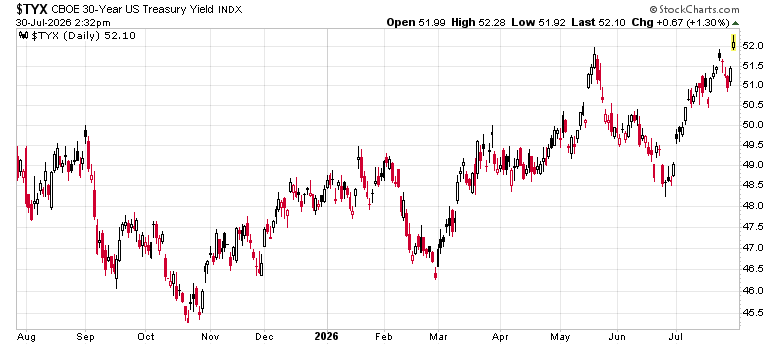
The difficulty of making money in a rising rate environment

It is exceedingly difficult to make money in a rising interest rate environment. Capitalized values of assets descend when discount rates go higher. Since financing is typically secured on the basis of asset value, when asset values drop, the leverage must decline and all sorts of spinoff effects occur down the financial chain.

From a political perspective, the way to bridge this inconvenient fact is to shovel money out into the economy and bail out the whole financial system by inducing demand to keep the asset prices high through deficit spending.

This is why any governments linked to the global financial system will be in perpetual deficit financing mode – to do otherwise will invite an economic collapse of epic proportions. This would lead to political instability and for the USA, a significant loss of control over a dollar-denominated economy (which currently gives them huge economic advantages).

The classic economic calculation of GDP is the addition of consumption, investment, net exports and… government spending.

The US government currently has a 6% budget deficit to GDP. The Canadian government deficit, combined with provincial deficits, is around 3%. Other than the removal of the Covid-19 one-time spending where every world government was shovelling money out to the populace (the inflationary aftermath of which we are still dealing with today), government spending continues to increase. If in some dream scenario the government wanted to balance the budget and decided to do so by reducing spending instead of raising taxes, it would trigger an instant recession. The analogy is that the economy is hopelessly addicted to government spending – and a withdrawal would cause huge tremors like a physically addicted heroin addict getting off the needle. Other major national governments are in similar situations across the globe – arbitrarily, the top 10 are all in deficit; looking at the top 20, rank 20 Switzerland is the only one in relative balance.

With US 10-year treasuries an inch away from hitting the symbolic 5% yield to maturity mark, this is causing a crisis of sorts – the least of which is that the asset collateral represented by such bonds has dropped in value. With a higher long-term interest rate, the cost of borrowing for private entities also becomes equivalently expensive as corporate bonds are priced with a spread to the “risk-free” rate of the US Treasury bond.

In Canada, we are seeing the 5-year Government of Canada bond trading at 3.6%, which is the highest it has been since early 2024. This has a direct bearing on the real estate market and rising interest rates have treated this asset class like a campfire with a wet blanket on top.

When deficit spending becomes too expensive, another lever to be pulled is to induce inflationary panic. This has been going on for quite some time, but nothing does this better than triggering a war – and wars cost lots of money, which needs to be funded with additional deficit spending – almost as good as Covid spending. Adding “fuel to the fire” is having a core industrial input cost (the price of diesel) rise to a point that is going to raise prices in a manner that no carbon tax could ever.

Keep in mind that the real rate of interest is the nominal rate minus the expected rate of inflation.

Even if the markets, which are vomiting on government debt, are demanding higher rates of interest, you can still trigger a decrease in the real rate of interest.

It is by triggering the fear of massive amounts of inflation. Whether the inflation actually occurs or not is another matter – consumption and capital spending get pulled forward ahead of anticipated price increases, and that behaviour by itself shows up in GDP. What is being discounted is the nominal rate against expected inflation, not against the inflation that eventually prints.

This is not what the reported statistics are showing at present. Canadian CPI is running at 3%, but the Bank of Canada’s core measures (CPI-trim at 2.0% and CPI-median at 1.9%) are sitting roughly at the 2% target. That gap between headline and core is partly due to the energy pass-through. I would argue it is the perception of higher inflation, rather than the reported statistics, that is driving behaviour.

There is a fair objection to all of this. If governments wanted inflationary panic, why did Ottawa suspend the federal fuel excise tax in April, and then extend the suspension through January 2027 at a total cost of about $5 billion? The answer is that a tax expenditure is still spending. The 10 cents a litre on gasoline and 4 cents on diesel is borrowed money handed straight to consumers at the point of highest propensity to spend – it suppresses the measured number without touching the underlying deficit condition. The tax returns at half rate in February and in full in April, which means the headline CPI quoted above has a mechanical increase already scheduled into it.

All of these financial machinations will create an oscillatory market where you have competing notions of valuation – cash flowing assets will degrade as the capitalized value of said asset will decrease with higher discount rates; physical asset values will rise, and the price of consumption will skyrocket. This makes real estate, for example, difficult to model – on one hand, you have cash flows that can be generated through rents – the present value of these cash flows will decrease due to the increase in the discount rate; conversely the asset value will rise in nominal terms due to the inflation that higher interest rates are signalling. An investor in Canadian Apartment Properties REIT (TSX: CAR.un) is currently sitting on an asset with (June 30, 2026) NAV of $54.38 per unit, but the units are trading, as of this writing, 40% under this. On the commercial end, Allied Properties (TSX: AP.un) is in a fight for its life and is trading at about 50% of its stated NAV. High interest rates today are causing the devaluation of these trusts, but assuming they survive without another dilutive recapitalization, there will be a time where cash flows from said properties will once again enter into the valuation of the units – say if CAR.un traded at a valuation of a 12% yield on its annualized FFO instead of its current 7.7%, would that be a better alternative in an environment where 5-year GoC rates are 3.6%?

Stock markets measure profitability in nominal terms. The eroding value of currency should never be confused with the underlying profitability of companies producing things that are in demand with limited competition, or that are the first-hand recipients of the money created through deficit spending.

There is an element of “damned if you do and damned if you don’t”, referring to the fact that one seemingly cannot invest in equities at all-time highs, yet if you are sitting in cash you are seeing the purchasing power erode very quickly. Even the precious metal complex (gold, platinum and silver) is not immune – the ebbs and flows of demand for them (both in their industrial metals capacity and their monetary metals capacity) do not give any assurance that in the short term you are holding onto a “safe” asset. Gold posting three consecutive weekly declines into a $100 oil shock makes the point rather neatly: it was the real rate doing the work, not the inflation headline.

Inflation expectations and government spending are the trigger to rising interest rates and consequential declines in purchasing power; these deficits are now baked in and will be competing against private capital. These times are reminiscent of what occurred in the second half of the 1970’s, with the material difference that real rates then were deeply negative on measured inflation while today they are positive on measured inflation and arguably negative only on the perceived kind. If this playbook is an apt analogy, it will be difficult to get ahead, in real terms, in this financial environment.

Fortunately, I am not an institutional pension fund investor who has to realize a return on a hundred billion dollars of capital. The advantage of being a small-time investor is there will always be nooks and crannies to retreat into for those better-than-average risk-reward opportunities. However, a rising-rate environment makes them much more difficult to find.
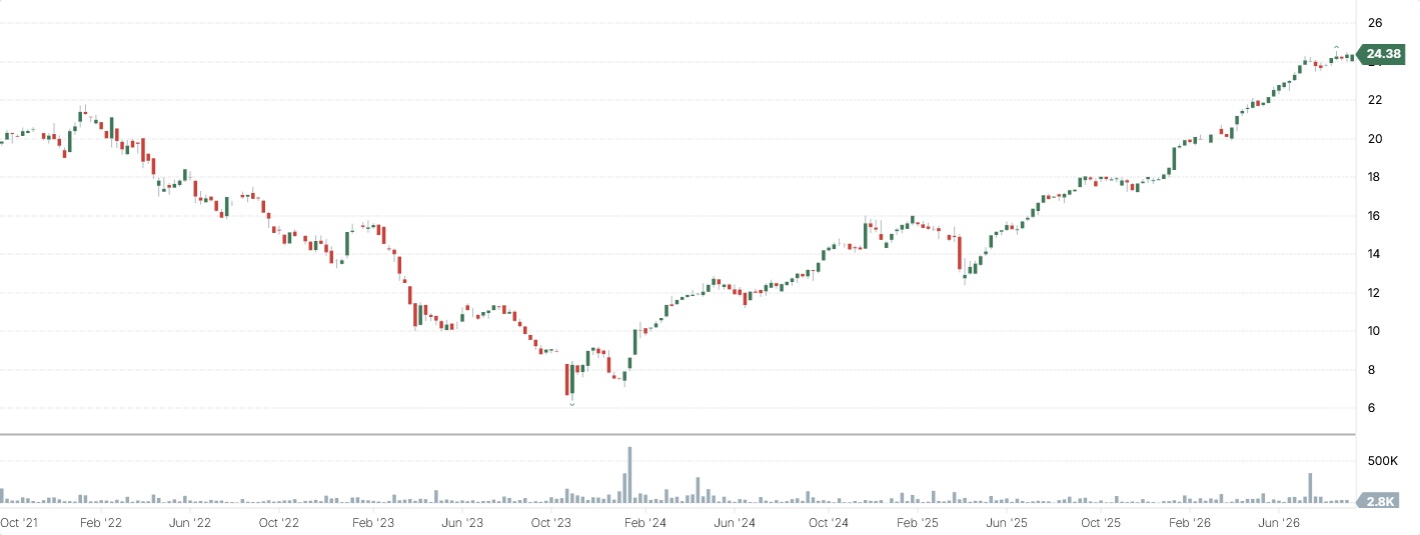
Brookfield Office Properties preferred shares – Yield on cost

One of the entrails of the Brookfield Property Partners is the merging with and guarantee of the preferred share obligations of Brookfield Office Properties. They trade on the TSX as BPO.PR.x and you can view the salient terms and conditions of the various securities on Brookfield’s surprisingly well-organized website.

At the end of 2023 these were dumped by the market as the office property market had cratered due to Covid-19 lease expirations and also due to tax-loss selling. There is not much of an organic demand-side for these shares as there are no structural preferences for non-Canadian residents (Canadian residents receive an advantage of an eligible dividend payment in non-registered accounts). Also, the Brookfield Office Properties entity itself is only part of the Brookfield Property Partners entity (technically the LP) which itself is a subsidiary of Brookfield Corporation. When reading the 6-K and 20-F filings, it is an incredibly complex structure and I do not pretend to understand it comprehensively other than that there is a significant equity buffer for unitholders and the dividends are likely to be paid for years ahead, barring some calamity in the regions they operate in.

Specifically, the BPO.PR.R issue was at a 4.3% coupon, and its rate reset is 3.48% every five years, October 1, 2026 being the upcoming reset date. The last time it did a rate reset, five-year government bond yields were at near record lows.

I bought my shares at $7.60, which translated into a 14.1% yield. Now the shares have reset their yield to 6.829%, which is a 22.5% yield on cost. Yield on cost is a completely meaningless financial metric but in the era where you will be lucky to get (a fully taxable) 2.5% on a high interest savings account, this trade can be chalked up in the “win” category.

It creates quite an interesting dilemma on when these securities should be sold. Given the cash-heavy position in the portfolio, it would make no sense to liquidate this. The only instances where it would make sense is that if I had some inkling that the dividend was no longer going to be paid, if I suddenly found a use for the portfolio’s idle cash, or if I was betting on a significant rise in interest rates (I could attempt to convert the preferred shares into floating rate shares which is effectively a bet that the average 3-month treasury bond yield over the next five years will be about 1% higher than it is presently – I do not think this is a good bet). In the meantime, I clip these very boring coupons.

The shares are a small fraction of my overall portfolio. I do have thoughts if I would have taken a 20% position back then in these preferred shares (as I was still about 40% cash at the time in question). It would have been quite the tax-preferred income stream.

Especially after my Teekay Offshore experiences, I am very aware Brookfield is by no means a benevolent corporation. Like anything in the capital marketplace, I am not treating this as a permanent income stream.

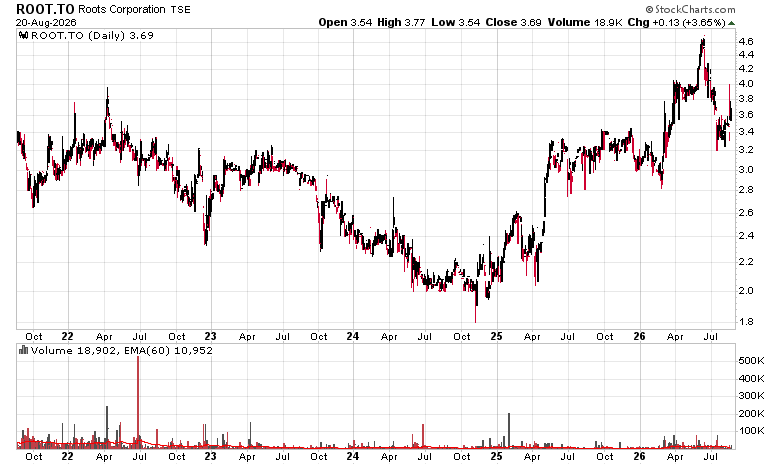
Roots taken out

I didn’t have this one in my portfolio, but I remember looking at Roots (TSX: ROOT) in late 2024 in my “tax loss selling discards” pile. The stock at the time was trading in the low 2’s.

Today they announced they received a takeover offer from a private firm for $4.10/share cash. It is very likely to be successful.

Note that Roots was already majority controlled by Searchlight Capital Partners, who decided on a liquidation outlet.

Despite being involved in retail fashion (which is a volatile industry that shareholders of Lululemon, Aritzia, etc. can attest to) and having zero growth in top-line revenues, they were quite good at carving out free cash flow annually out of the business. Perhaps I should have been a little more appreciative a couple years ago at management’s efforts at chipping away the debt in the business and staying in their lane.

With an average of $29 million a year in free cash flow for the past 3 fiscal years, the company was trading at an EV/FCF ratio of about 13-14% and you just had to make the assumption they were going to hold the line (I was a little more pessimistic at their prospects and decided to pass). C’est la vie!

Generalized advice on dealing with share buybacks

There are two ways you can ultimately realize cash from an investment.

One is that the company issues a dividend. The second is you sell the stock (whether it is forced upon you or not – for the purposes of this post, I am assuming that your shares are not being forcibly bought out).

There is a whole bunch of academic literature on question of whether dividends or share buybacks are the best form of returning cash to shareholders. In theory, when removing the impact of taxes and transaction costs, there is an indifference between a dollar returned via dividends or through share buybacks. However, the cliche of “in theory, theory and practice are the same, but in practice they are different” applies.

Since I can remember, the debate whether dividends or share buybacks provide the superior return mechanism has resulted in very different philosophies between various management teams.

The core issue is that a dividend triggers a tax hit today (in addition to the top marginal rate being significantly more expensive for a dollar of dividends versus a dollar of capital gains) while a buyback is perpetual (to the extent that management doesn’t mess up and issue shares for cheaper later!) and cumulative. A buyback does, however, trigger a 2% share buyback tax in Canada which does offset this differential somewhat. A buyback also has the effect of elevating a company’s share price for a temporary period of time due to the demand on the stock during the period of the buyback – this will also elevate the cost to shareholders for management compensation as in many cases there are RSUs, options and other stock price-linked financial instruments that will accrue to management’s pockets.

Over the course of a couple decades, I’ve assembled my practical rules of caution concerning companies that engage in share buybacks:

1. If the company’s balance sheet is debt-laden, be very cautious when they execute share buybacks and considering paring, if not outright selling entirely the company.

and in conjunction – 2. If a company decides to incur additional debt in order to buy back shares, be cautious.

Rule 2 is due to a “non-debt laden” company deciding to take out debt in order to repurchase shares.

Needless to say, if the company’s balance sheet has other priorities, stock buybacks can be very dangerous to a company’s financial health.

Essentially management is making a decision that the cost of their debt is lower than what returns will accrue to the shareholders. From a metrics-perspective, this will increase the return on equity but does not increase any fundamental profitability of the company itself. As long as these calculations are correct and the company can continue to deliver sustained profitability at or greater than the cost of debt, coupled with the gross amount of debt not presenting any liquidity/solvency challenges when it comes time to roll over said debt, it will give the present shareholders a one-time boost.

Ag Growth (TSX: AFN) (late 2024/early 2025) is a poster child for this rule. They repurchased shares in the upper 40s and the stock is now sitting at $14 – with a looming refinancing on the horizon.

Dye and Durham (TSX: DND) is another great example – in fiscal (June 30) 2023, they repurchased $223 million in stock. The buyback was entirely funded by debt.

This category also covers the cases where companies are performing significant amounts of expansionary capital expenditures at the same time as executing a share buyback – capital that otherwise would go to expanding the profitability of the business is instead directed to share buybacks – why not just allocate it all to the capital project (or acquisition)?

3. If the company’s management performs a buyback when share prices are at all-time highs, be cautious and consider paring into the demand.

Many tech companies have gotten in trouble with this rule – valuation insensitive buybacks are destructive.

The year 2000 is littered with examples of this, but in more recent times, we have amusing examples of Silicon Valley Bank (SVB) repurchasing shares in 2022 (and going bust in 2023), Enphase buying back stock in 2022-2023 at around $200/share, etc. Lululemon was repurchasing shares at $350-450/share in FY2023-2024, and the list goes on and on.

4. If the industry is cyclical and the company is buying back stock, be cautious.

Good examples here include Western Forest Products (TSX: WEF) which repurchased about $120 million in stock (at much higher prices) in 2021 and 2022 during the Covid lumber boom, and Alpha Metallurgical Coal (NYSE: AMR) which repurchased over $1 billion in stock in 2022-2023 during the coal boom. Note that both of these companies have relatively low amounts of debt on the balance sheet presently, so they were truly disposing available cash at the time.

Teck was going to be one of these stories until they stopped their buyback after the Anglo American buyout announcement!

All of the oil and gas majors in Canada right now are gushing cash flow and are repurchasing shares at all-time highs – looking at Cenovus Energy, for example – in the past 12 months they have given out $1.5 billion in dividends, and repurchased $3.2 billion in stock. That said, the majors have mostly de-levered themselves so the “what to do with the cash” problem is pleasant for them to deal with – CNQ have decided to go with a more dividend-heavy route, and companies like Tourmaline and Peyto reject buybacks entirely.

In my experience, when a company buys back its own shares, it is more of a reason for caution than celebration. There are two cases where buybacks are beneficial:

1. Management uses an appropriate valuation metric to decide whether to buy back shares.

If a management team can restrain themselves to only repurchasing below a certain valuation, it is likely a sign of well-allocated capital. Examples coming to mind include Mullen Group (TSX: MTL), whose last repurchase was at $14/share, or Magellan Aerospace, where they last repurchased shares at an average of $15/share. Both companies have share prices in excess of this, and management has stopped buying back shares. Andrew Peller (TSX: ADW.a) repurchased a small amount of its Class A shares in the 4’s before stopping.

2. The company perpetually generates positive cash flows.

A very special case is Corvel (Nasdaq: CRVL) which has been repurchasing shares for the past 3 decades. While they have sped up and slowed down their buybacks over the years in accordance to their stock price, the buyback has been wildly accretive to shareholders. NVR is another company that has derived its returns entirely through share buybacks.

However, just because such a buyback has been historically a good decision does not necessarily mean it will be in the future – and an investor needs to always be aware of that.

If you are holding shares in a company, at the very least you do not believe it is worth selling at the current price (taking into account capital gains taxes and/or reinvestment alternatives). If a company is on the upper threshold of your valuation metric and then decides to purchase shares off the open market, there is only one good way to defend against a share buyback that is commenced for wrong reasons – and that is to sell your shares while the price of the stock is temporarily elevated by management. Chances are, after the buyback is concluded, you would likely be able to purchase shares at a lower price some point in the future.

There is no “one rule for everything” with respect to this topic – every situation has to be individually analyzed – but the above are some considerations in mind – not an exhaustive list.

Beware the long-term interest rate

30-year US treasury bond yields reached a high that has not been seen for 2 decades today.

When making financial decisions, your nominal benchmark for a risk-free long-term return is this financial instrument. Of course you have to factor in whether the US currency will actually be able to purchase anything in 30 years, this is all part of the risk equation. On the flip side, if the US Federal Reserve starts to do quantitative easing in the event of the next global depression, your trade will work out very well.

In the meantime, the higher this yield goes, the more pressure there will be on equity pricing.